

How Is Your Genetic Makeup Different From A Sibling?
Sibling Deoxyribonucleic acid means you're more than similar than anyone else, just practise you share the same Dna? Not really. Hither's why your parents didn't make exact replicas.
Results of Deoxyribonucleic acid testing for siblings can be cause for confusion. Specially since you could have different Deoxyribonucleic acid percentages in the ethnicity section. Don't worry, we'll walk you through the scientific discipline of gene inheritance, how much Deoxyribonucleic acid do siblings share, and explicate why surprising differences can occur.
Table of contents
- Tin a kid take more ethnicity than a parent?
- Practise siblings have the same Deoxyribonucleic acid?
- How much DNA comes from each parent?
- Why do siblings only share 50% of genes?
- Sibling Dna: exercise twins share the same DNA?
Can a kid have more ethnicity than a parent?
Imagine your sister took the Atlas Deoxyribonucleic acid examination. She tin't wait to tell you well-nigh her personalised health suggestions and an odd photic sneeze reflex. Feeling a lilliputian jealous, you become curious about your Deoxyribonucleic acid too.
Concluding year, the National Geographic wrote about twin girls born with different pare color. One child inherited the mother'due south genes, and the other, the father'due south. Nonetheless their situation is not unique, and it's not a question of how accurate is the sibling DNA test.

Skin pigmentation, eye, and hair color are features defined by your DNA. This was demonstrated past these ii girls who showed that twin DNA can be very different. That'southward why, even with the aforementioned parents, you lot only share some of your genes with your kin - about 50% (only that's something nosotros'll get into further on).
That's considering the human being trunk has several biological mechanisms that can create an almost space number of gene combinations. And that's what gives brothers and sisters dissimilar DNA.
Do siblings have the same DNA?
Instead of beingness stored equally a single massive molecule, Deoxyribonucleic acid is packed into special units, called chromosomes. Scientists have numbered man chromosome pairs from 1 to 23 which allows them to locate and draw specific genes.
The cells in your body have a copy of your DNA. About cells are diploid, which means that they have two copies of each chromosome. One comes from your mother, and the other - from your male parent, which adds up to a total of 46 chromosomes.
The 23rd pair of chromosomes is particularly interesting when it comes to brother and sister Dna, considering they define biological sex. Girls (XX) inherit an X chromosome from both parents, but boys (XY) always get a Y instead of an X from their fathers.
X and Y chromosome differences mean that brothers and sisters can never accept identical genotypes. However, brothers take the aforementioned DNA on their Y chromosomes.
How much Deoxyribonucleic acid comes from each parent?
A process called meiosis ensures siblings share but well-nigh fifty% of their genotype. That'due south how siblings tin have different Dna.
Meiosis is a form of cell division that is only used to produce a special category of cells, called gametes. Depending on your biological sex activity, your body produces one type of gametes: either sperm or egg cells.
Unlike the rest of your cells, gametes are haploid, pregnant that they have just i copy of each chromosome. This ensures that your child receives just one prepare of genes from yous, and the rest comes from your partner.
Every kid gets 50% of their genome from each parent, but it is always a different 50%. During meiosis, gametes get a random chromosome from each pair. This means that there are over 8 million possible Dna combinations from 23 chromosome sets!
The probability of two siblings receiving the same 23 chromosome sets from both parents is negligible. Withal, random chromosome selection is not the end of the story. Nature has another mechanism to further differentiate brother and sister Dna.
Messy meiosis
Scientists find like and unlike genes in siblings, often fifty-fifty on the same chromosome. This botch is possible because of a biological mechanism chosen chromosomal crossover.
Chromosomal crossover happens when a diploid prison cell divides into iv cells to make sperm or egg cells. When crossing over, chromosome pairs are brought together to commutation small pieces.
The genes transferred from one chromosome end upwardly in the same location on the other chromosome. Because of this bandy, gametes receive a unique jigsaw puzzle assembled from the 2 original sources. This generates even more diversity between sibling Dna.
Whenever someone compares the genetic moving picture of brothers and sisters and declares that siblings share 50% of their Deoxyribonucleic acid, they don't really mean 50% of all Deoxyribonucleic acid. Rather, scientists are really looking for tiny differences in genes.
Every gene is made upwards from thousands of one-letter Dna blocks: adenine (A), thymine (T), guanine (G), and cytosine (C). Our cells apply these sequences as blueprints to produce proteins - molecular machines with specialised functions.
99% of DNA is the same for all people - otherwise the blueprints wouldn't work. Nevertheless, a single-letter modify in sure genes doesn't change the protein recipe besides much. These alterations are called single nucleotide polymorphisms (SNPs).
For example, when sibling DNA testing concludes that brothers share 43% of their genes, information technology actually means that the siblings share 43% of tested SNPs. And if you're wondering how much DNA practise half siblings share…well it's well-nigh 25%.
Even without a Deoxyribonucleic acid test, it is easy to spot that identical twins share more than features than most brothers and sisters. Identical twins are born when one zygote (formed by a sperm and an egg jail cell) splits into 2 foetuses.
That's why these rare cases are known as monozygotic twins: the two children are formed past the aforementioned gametes, inherit the same genes, and therefore have identical DNA test results. All the same, they are not exactly the same.
Identical twins are the merely siblings that share 100% of their Dna. Non-identical brothers and sisters share about 50% of inherited gene variants, which is why siblings and fraternal twins can exist so different.
However, monozygotic twins can have different food preferences, torso weight, personalities, and other features – all shaped past a combination of genes and the environment. Inquiry as well shows that their gut microbiome – an ecosystem of microorganisms in every man colon – can be very different besides.
☝️TIP☝️Discover your gut bacteria and their functions with the Atlas Microbiome Test and get 10% off when yous sign up for blog updates!
Genetic beginnings testing with Atlas
The Atlas Deoxyribonucleic acid Test tin can tell yous about the geographical origins in your DNA, merely it won't link you to long-lost cousins.
Many different types of Dna Tests can now exist bought online, and each one offers different insights into your genetic make-upwardly. Atlas is a health-focused visitor, so we can tell you if you're a carrier of hereditary disease cistron variants passed on to your by your parents.
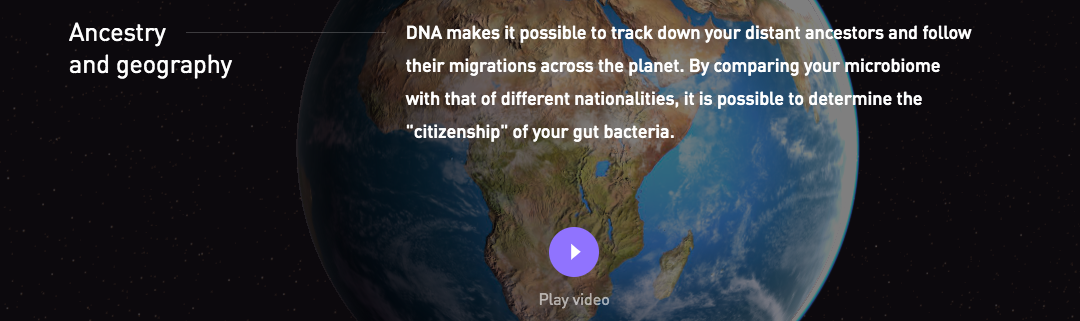
If you accept the Atlas DNA Test, you lot'll also discover what percentage of Neanderthal genes resides in your DNA design, and where your ancestors came from. There's even a dynamic map that tracks their migrations across the globe.
If you're planning on conceiving a baby, you can also take the test with your partner and consult our genetic counsellor to see if you might pass on whatsoever inherited disease risks to your future children.
What you tin learn from an Atlas Deoxyribonucleic acid Exam
| Common affliction risks | Hereditary disease condition |
| Nutrition and metabolism | Personal and sports traits |
| Genetic ancestry | Personalised lifestyle insights |
☝️TIP☝️Don't forget to fill in the Health Survey in your personal account to get the most authentic insights into your wellbeing based on your lifestyle and environment.
- Jones GH et al., Meiotic Crossing-over: Obligation and Interference, 2006.
- Kutschera U & Niklas, KJ, The modern theory of biological evolution: an expanded synthesis. Naturwissenschaften, 2004.
- Montag, C et al., The Role of Nature and Nurture for Individual Differences in Primary Emotional Systems: Prove from a Twin Written report. 2016
Source: https://atlasbiomed.com/blog/do-siblings-have-the-same-dna-the-facts-on-family-genetics/
Posted by: watsonbuttly.blogspot.com
0 Response to "How Is Your Genetic Makeup Different From A Sibling?"
Post a Comment