

How To Draw A Red Head Girl
How to draw a caput: A complete guide
How to draw a head
Drawing a realistic head isn't easy, but this guide from Olivier Sin will help yous to primary the art. Read on...
15 tips for drawing heads realistically
This workshop will take you through all aspects of my drawing method. I'll reveal my cardinal composition techniques, which range from establishing a point of view to applying key illustration principles for creating an accurate and expressive likeness of the human being head.
You lot'll also larn how to utilise what I consider to be the essentials of human facial anatomy, and explore how the concepts of value, shapes and aeroplane changes affect a portrait'due south underlying structure. Elsewhere in this article I'll reveal my techniques for creating depth and dimension, and investigate how contrasting shapes are used to heighten depth in an illustration.
If your effigy drawings are looking a little flat, then fearfulness not – I'll besides be covering how to create the illusion of three dimensions when cartoon on a flat surface. I'll examine how edges – contours as well every bit changes in value – are used to convey three- dimensional class. And it's important to call back that not all portraits have to work in isolation. In this article I'll also exist demonstrating how expressive hands, facial hair and the correct choice of groundwork can all enhance the finished slice, and make for a more pleasing viewing feel. Then grab that charcoal stick and let'due south start drawing!
01. Use line expressively

(Image: © Oliver Sin)
I drew these portraits with expressive lines by using just the tip of the the vine charcoal, without blending with the flat side. I use lines depict the form of the caput. It'southward been said that a line is a moving dot, or a point in movement. A line can guide a viewer's eye by defining edges and outlining shapes. Lines used to outline a shape are called profile or contour lines. The five types of lines are vertical lines, horizontal lines, diagonal lines, zig-zag lines and curved lines.
02. Consider your shapes

(Prototype: © Oliver Sin)
A shape is a closed contour, created when a line is enclosed, or when the ends of a line meet. All shapes are two-dimensional – they take both length and width. There are two types of shapes: geometric and organic. Geometric shapes include circles, triangles and squares. Organic shapes are those irregular, uneven shapes that seem to follow no rules; these expressive shapes are typically non man- made. I utilize more often than not geometric shapes to depict a contour lines head drawings.
03. Sympathize shapes
(Prototype: © Oliver Sin)
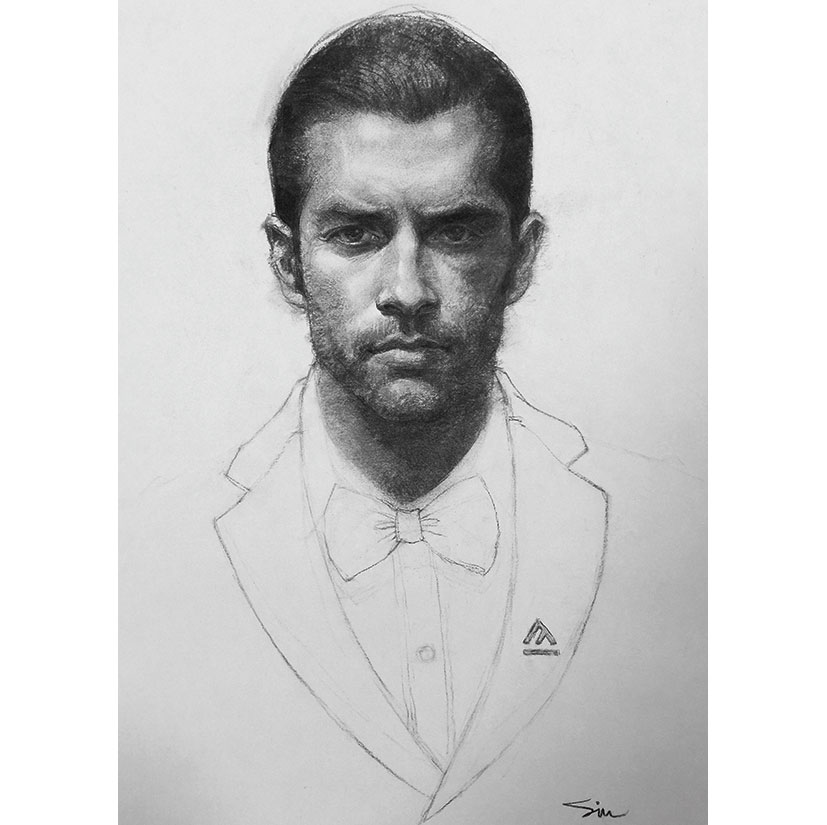
Form and shape are related. I think of forms equally three-dimensional shapes. In fine art, the term form refers to an object that has length, width and height. I encourage you to develop your understanding of grade, and how to create the illusion of class in head drawings, by studying the result of light on objects. I prefer top lighting, which highlights the top-facing planes and casts extreme shadows. It's best to use a single light source to low-cal the head for portraiture.
04. Know the power of values
(Image: © Oliver Sin)
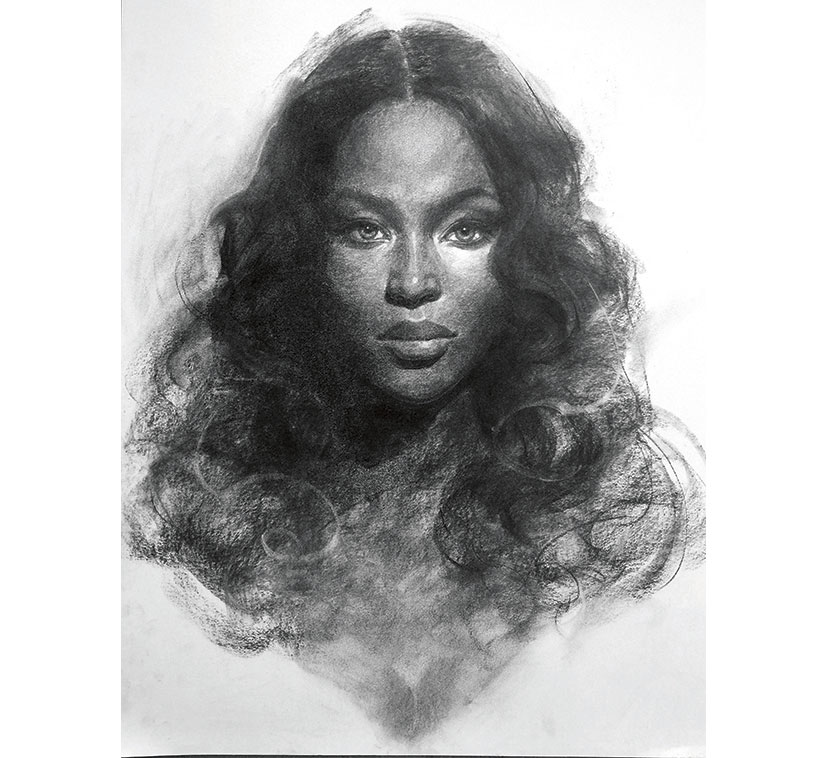
Value refers to the lightness or darkness of a tone. Value is crucial in a cartoon because low-cal and dark values describe the form of an object. All objects take a highlight, calorie-free, mid- tone, core shadow and reflected light, and I oft employ this five-value arrangement to my portrait drawings. Value is the key to the illusion of light, and a realistic drawing depends on a range of values. When drawing portraits, calorie-free and shadow translate from simple planes and shapes into detailed variations of value and line.
05. Apply a five-value organisation to your portrait
(Paradigm: © Oliver Sin)
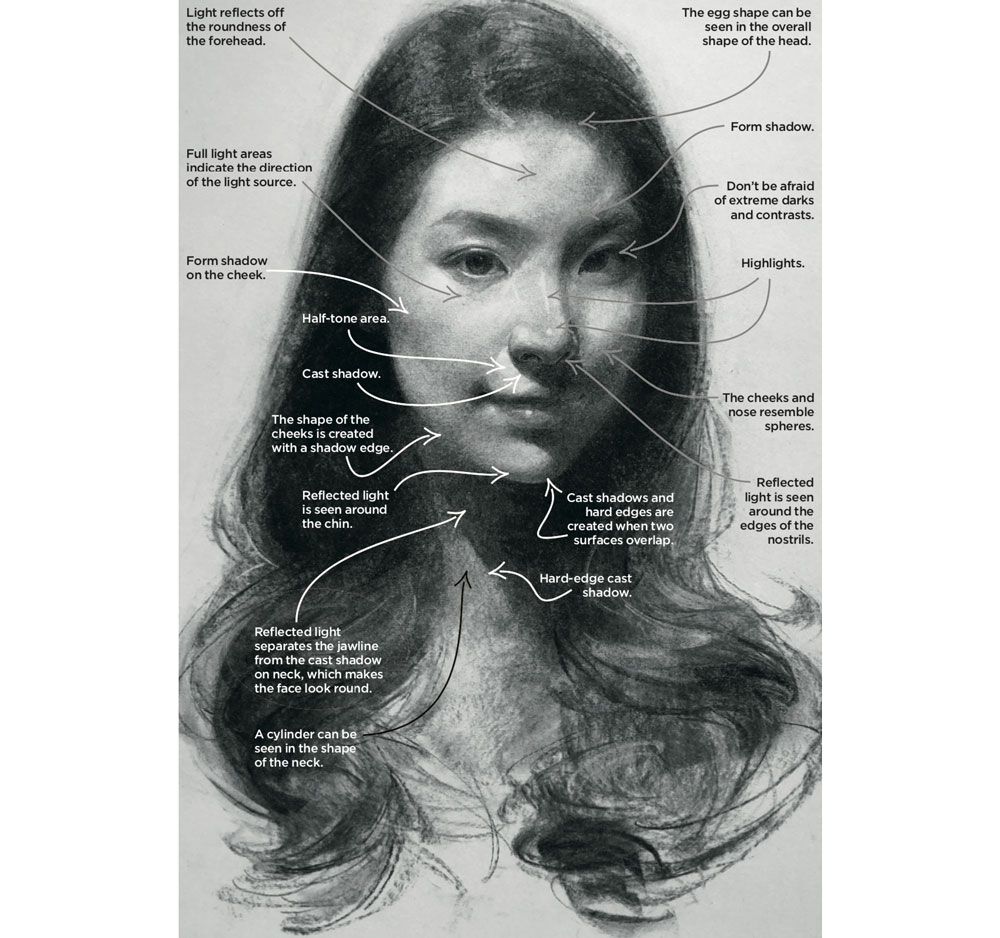
Geometric shapes can exist institute throughout the confront: an egg shape for the head; spheres in facial features such as the cheek and olfactory organ; and a cylinder for the neck. Light reflects off the roundness of the brow.
Don't be afraid of farthermost darks and contrasts. Reflected light tin be seen around the edges of the nostrils. Cast shadows and hard edges are created when two surfaces overlap. There's a hard edge on a cast shadow of the neck in this example. A class shadow is created on an object equally its surface turns abroad from the light source, and it has soft edges. A cast shadow is created when light is blocked from an object. It has hard edges, with an abrupt change from light to dark.
06. Combine line and value
(Image: © Oliver Sin)
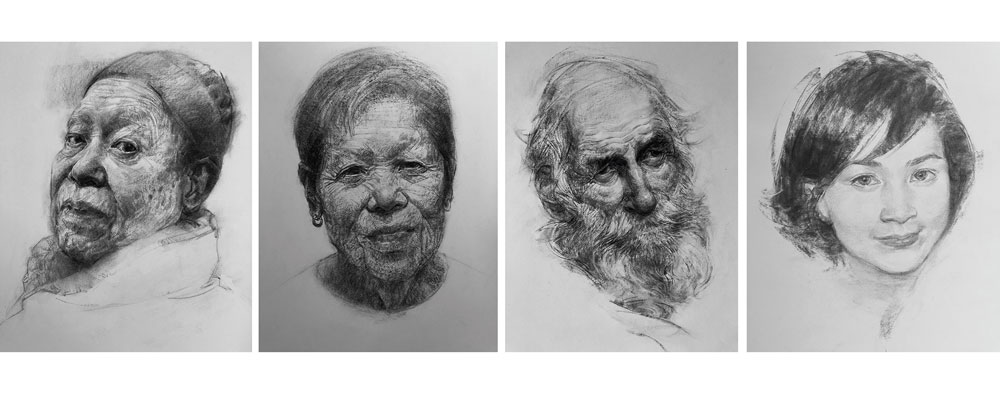
Line and value work together to create a likeness of the model. Value refers to the lightness or darkness of a colour or tone. Drawing areas of value lone ensures an artist becomes more than aware of masses, forms and low-cal. Drawing lines encourages the artist to study, judge and plan before drawing. The noesis gained from line-drawing helps the artist brand decisions about the edges of each area of tone as they develop the values. When drawing portraits, light and shadow translate from simple planes and shapes into detailed variations of value and line.
07. Employ value contrast
(Paradigm: © Oliver Sin)
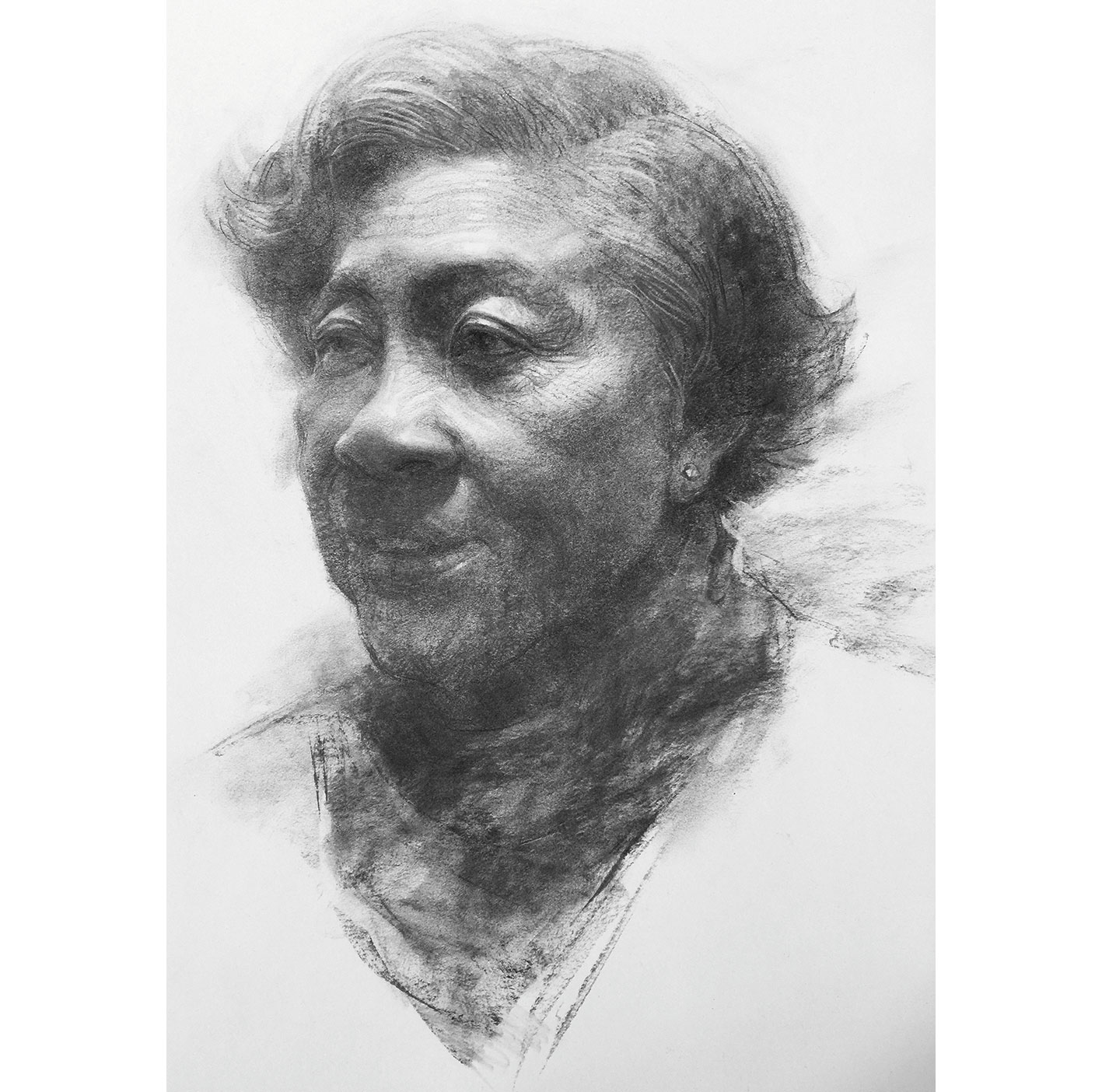
Value contrast is the best way to create the illusion of depth. Areas with a lot of contrast will come frontwards; areas with little contrast will recede. In this piece, equally the scarf wraps effectually the cervix I pushed information technology back visually by lowering the contrast, using similar values within information technology and drawing a thin line to suggest an border. It becomes less visible as it recedes, instead of outlining its shape which would requite information technology its own separate value.
I applied the aforementioned arroyo at the crown of the caput by gradually lightening the value of the pilus so it recedes into the groundwork. Reducing value contrast at the perimeters of the face up draws the eye to its middle, where I used loftier contrast between the left eye socket and the forehead.
08. Use foreshortening when in 3-quarter view
(Epitome: © Oliver Sin)
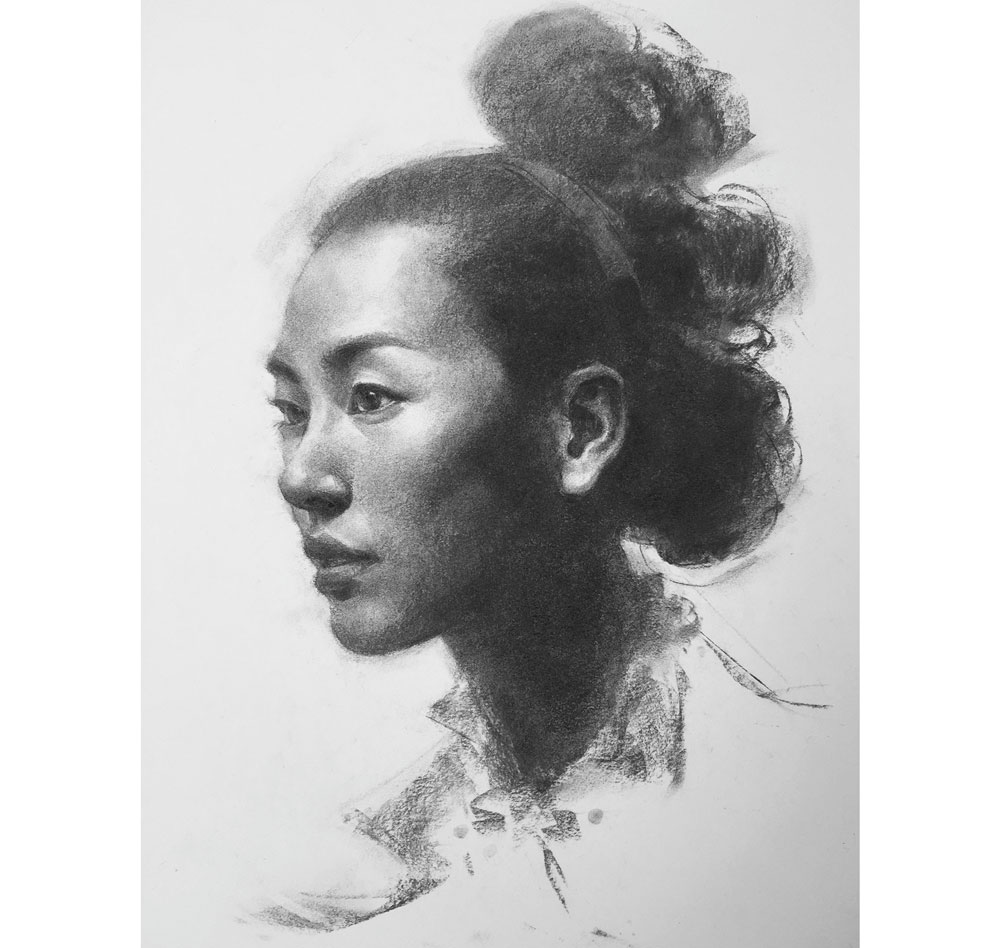
When the head is viewed at three-quarter angle, the perspective of the facial features are skewed. Foreshortening causes the closest parts of an object to appear larger than those farther away. Report proportion variation and measure the distance between features. Three-quarter
view places the accent on the closest eye as the focal point. The eyes and eyebrows reveal the mood of your subject – they can bear witness emotion and personality. The most side of the face is wider than the far side considering of foreshortened perspective. The cheekbone is more defined on the far side of the face, with a harder contour line.
Want to know more nearly foreshortening? See our guide to foreshortening in art.
09. Consider the difference between head cartoon vs portrait drawing

(Image: © Oliver Sin)
There'south a difference betwixt head drawing and portrait drawing. Caput drawing focuses on shapes, plane changes, anatomy, class and the perspective of the head. Portrait drawing is an artist's representation of a person'southward spirit: their expression, likeness, personality and mood. The "form" of the head refers merely to the external appearance of the face.
To draw spirited portraits, y'all must consider what bulletin – or perception – a portrait will communicate. The artist'due south personal perception is the common denominator of every piece of work of fine art he or she creates. Each artwork reflects the unique perspective of the creative person, no thing the mode or subject. I would say that a skilful cartoon features something that comes from within the artist.
x. Recognise the effect of contrapposto on the caput and neck

(Image: © Oliver Sin)
The position of the head and the neck establish the attitude of the portrait and hints at the emotion of the model. Besides the angle of the caput, look for the stretch and compression in the neck that reinforces the gesture. The word contrapposto describes the twisting activity of the torso. When a figure twists the torso, does the neck.
Train your heed to recognise contrapposto and its event on the neck. I oftentimes ask models to thrust the head frontward and upward, and the stretch of the model's cervix expresses a haughty gracefulness. One of my favourite poses has the model, with a dreamy look in their eyes, looking at the viewer over their shoulder.
11. How to draw an expressive portrait
a). Describe the shapes
(Image: © Oliver Sin)
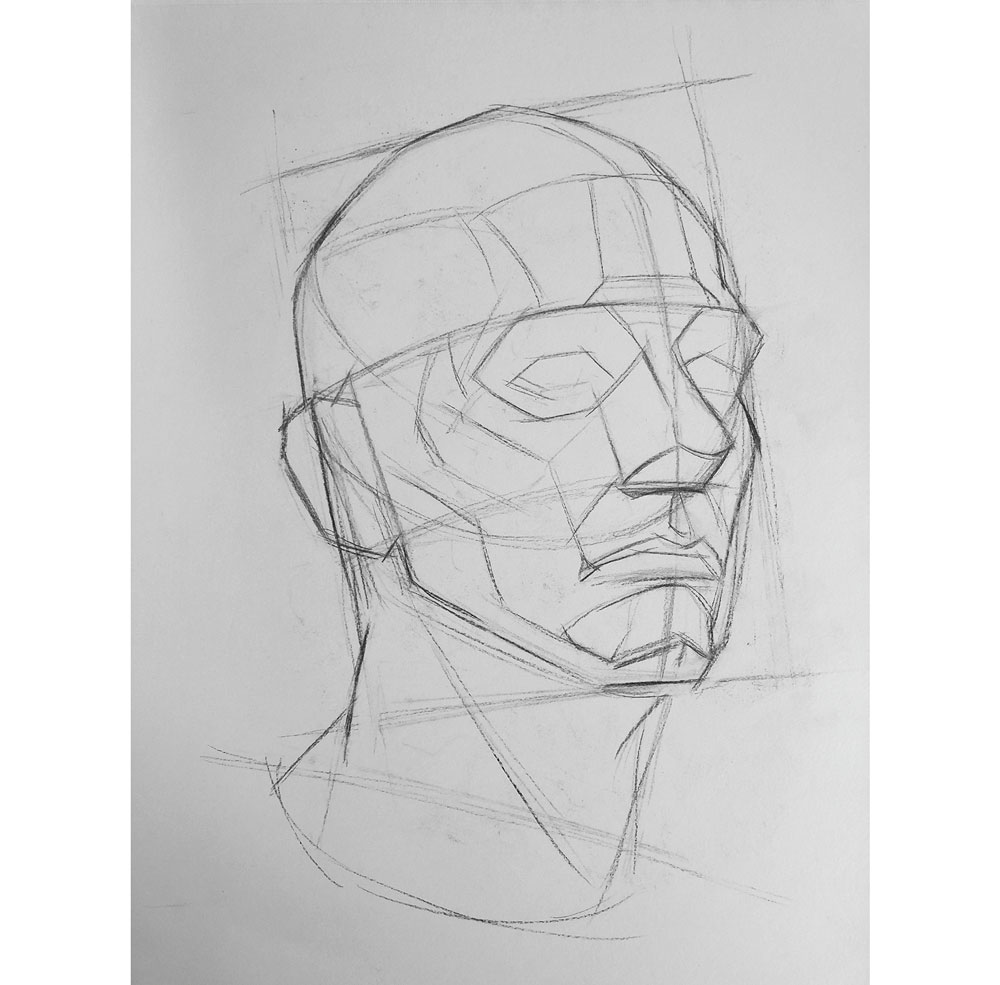
Use vine charcoal to map the position of the head by mark the superlative, bottom and side boundaries with directly lines. Straight lines enable you to observe the discipline every bit a whole and examine the relationships between key blocks and then yous can define them accurately on paper.
Depict a ball shape for the skull and a U-shape for the jaw. Institute the cantankerous where the middle line of the confront crosses the eyebrow line. Identify and divide the head into thirds: one- third from the hairline to the eyebrows, i-third from the eyebrows to the nose, and one- third from the nose to the mentum. The lower lip is halfway between the nose and the chin. Avoid specific details – just map out the caput's full general proportions.
Go along to utilise straight lines to define the large shadow areas, such every bit the eye sockets. I'd depict the centre sockets shapes first, then the base of the nose shape before the oral cavity shapes. Define the approximate shapes of the head'southward outline and mark the eyebrow. Notice the shape of the chin's bottom plane, which is foreshortened because of the angle of the head.
b). Ascertain planes

(Prototype: © Oliver Sin)
Proceed to define the shape of the ear, which aligns with the forehead line and the bottom of the olfactory organ. Ascertain the planes of the brow, cheekbones, nose and chin with straight lines. Study the proportions and relationships of the shapes to one another. Avoid adding details such as the pupils and nostrils for at present.
Use lines to ascertain areas of shadow and where planes meet, such as the front, sides and gradient of the forehead, and the front, wings and base of the nose. Mark the shapes and positions of the brow arch, cheekbones, temporal bones, chin and jaw. Care for this drawing as a blueprint. Use the broad side of the vine charcoal to brainstorm blocking in values to build the construction of the head. Recollect that all objects have light, middle, and dark values when exposed to low-cal. Hatch the shadow areas of the head, such as the eye sockets, and continue into the dark shadow of the cheekbone and other shadow areas. Railroad train your eyes to unify the shadow areas, while avoid seeing individual facial details. You could reduce the textures by blending the surface with your fingertips or a stump.
c). Showtime detailing
(Prototype: © Oliver Sin)
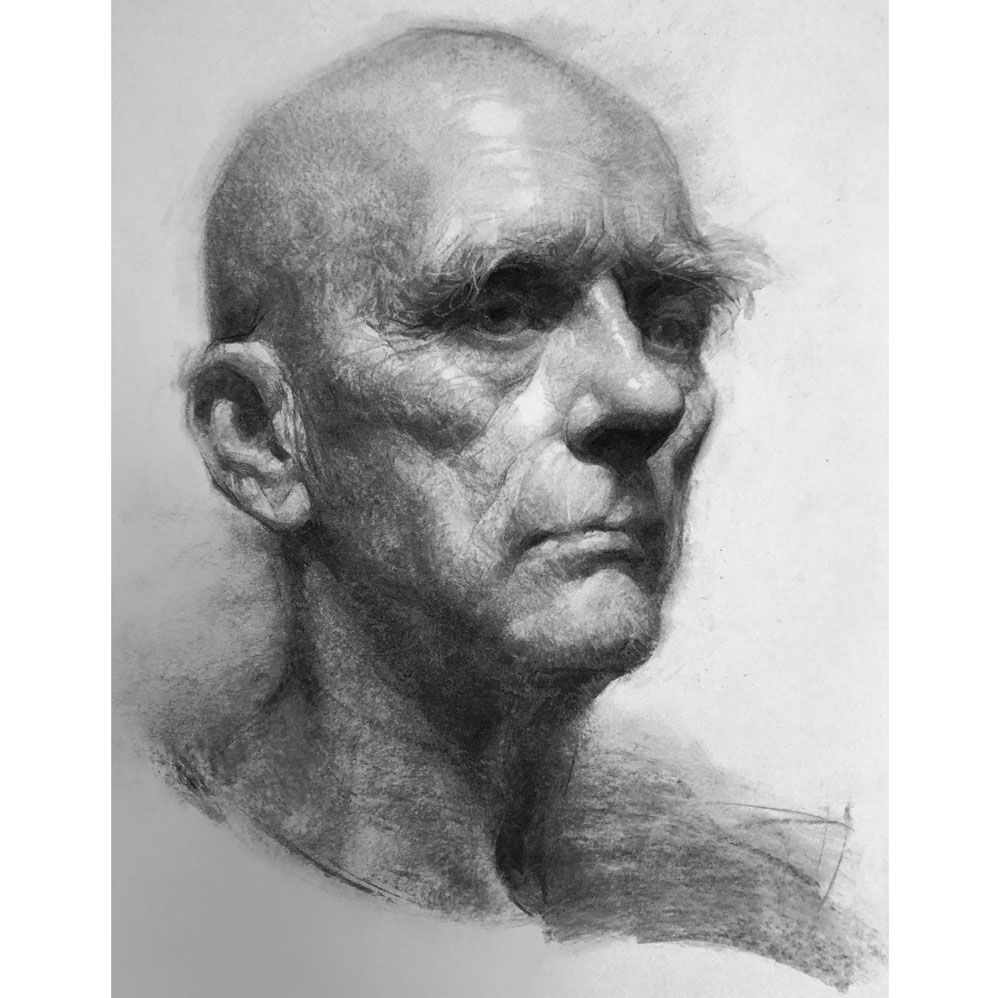
In each area where you work on details, reexamine the shapes of the dissimilar parts, paying attending to the strokes so that in that location's variation in hard and soft edges. Wherever you lot add item, shade the unabridged area first, then pull out highlights with an eraser and so apply a charcoal pencil to emphasise the shadows.
Wrinkles tin can enrich the drawing with texture and details. Wrinkles shouldn't stand up out and must correspond to the shapes of the facial features. Focus on conveying an impression of wrinkles, rather than drawing all of them.
Terminate by reexamining the light, mid-tone and dark values, likewise as the edges of the confront. Each of the three major values should be further rendered into iii more values, together with the highlight, for a wide value range that captures the forms. The edges of the face shouldn't course one continuous line, simply instead contain rhythm, spatial relationships and variation.
Reinforce the boundary between light and night on the chin to solidify this facial feature and softly stand for the structure and texture. Finally, reinforce the dark areas even more by adding willow charcoal with vine charcoal.
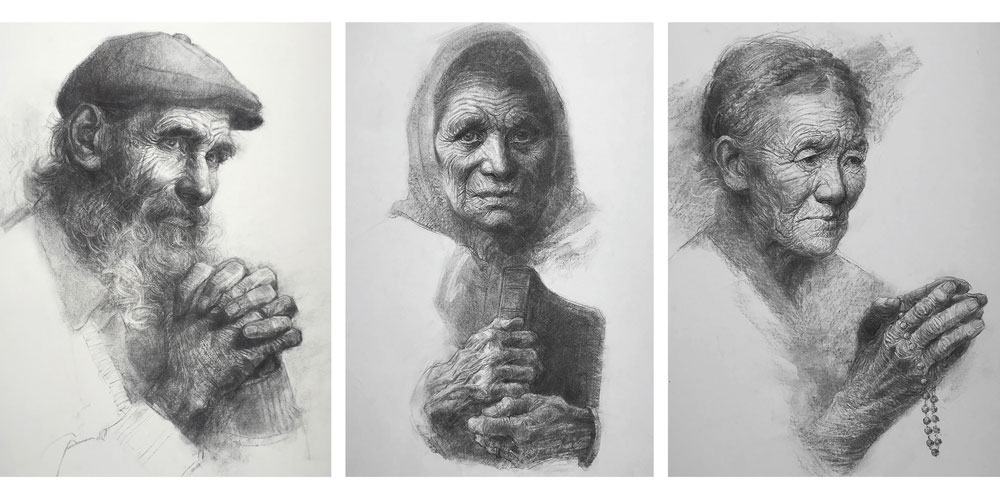
12. Express mood with the hands
(Image: © Oliver Sin)
Hands add emotion and feeling to a drawing. Including the hands tin can turn a regular portrait into a grapheme study: a aboveboard, unposed arroyo that reveals the subject'due south personality. On a philosophical level, hands stand for the way we touch on and feel objects, or even other people – how we 'connect' with the outside world.
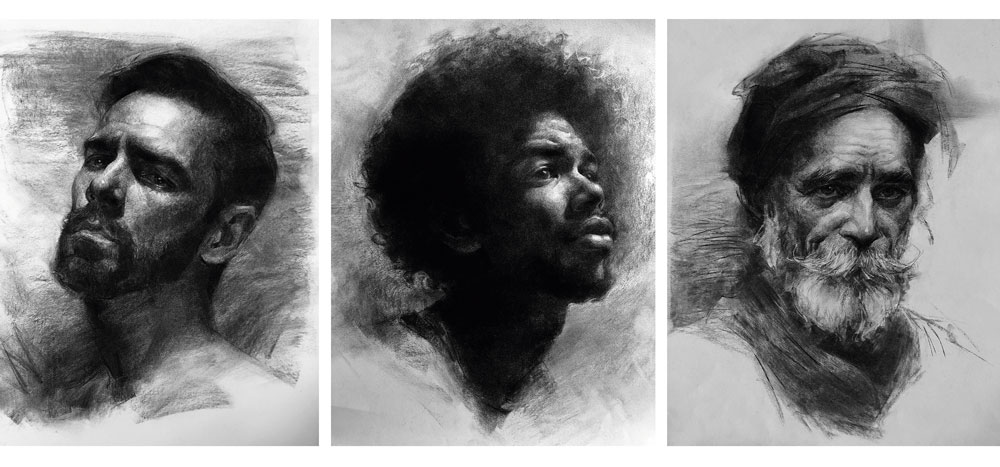
13. Consider a texture background
(Paradigm: © Oliver Sin)
The texture background tin play a key office in the visual statement of a drawing. A groundwork tin give an artwork a soft, calm look, or liven a piece with an energetic hit approach. Incorporating a creative groundwork in your art shouldn't accept the focus away from the subject.
Concentrate on the lights and darks of the subject when selecting a groundwork treatment. If the subject area is light on one side, a dark tone behind will show the contours more than conspicuously. Use the groundwork to testify off the contrast and enhance your piece of work, non compete with it. There's no formula for achieving the right background, and then exist creative!
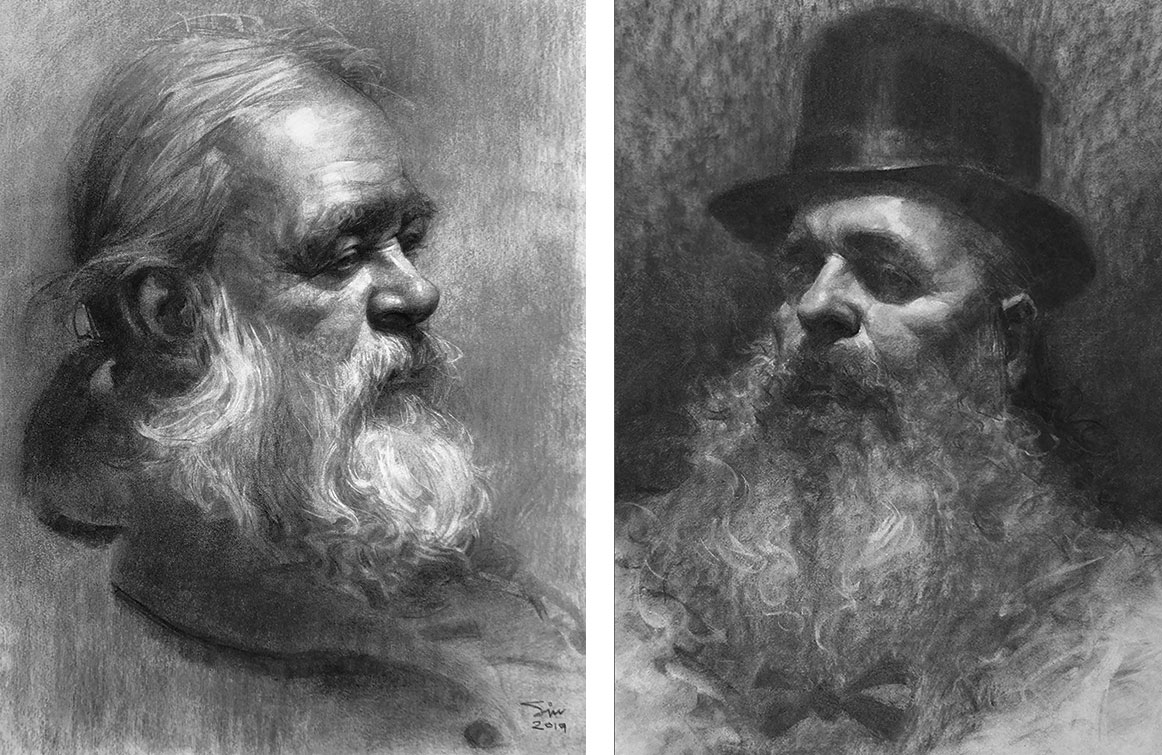
14. Create facial hair
(Prototype: © Oliver Sin)
Every moustache or beard is different, but there are several primal things to await for. The nose casts a shadow on the moustache, and the moustache casts a shadow on the mouth. If the moustache is very total, information technology may cover the upper lip. Call back of the moustache equally a large upper lip that wraps effectually the mouth, producing larger shadows. Follow the light and shadow on the caput if the planes aren't visible in the facial pilus.
Pay attention to the beard's shape, and train your eye to run into that pilus has no definable edge, like smoke. Rather than drawing individual hairs, care for the beard every bit a mass of light and shadow, keeping the edges soft.
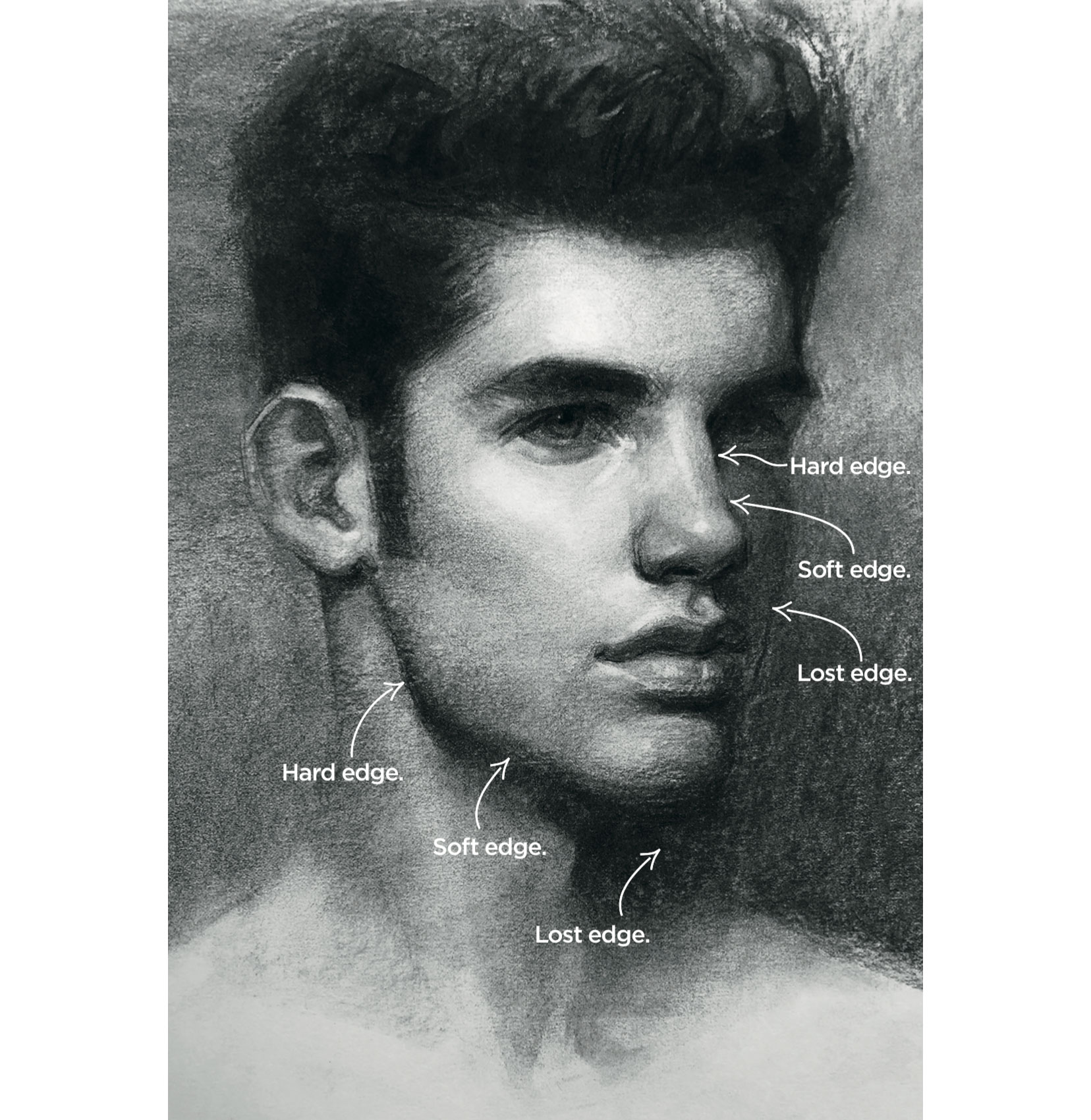
15. Employ edges to convey course
(Image: © Oliver Sin)
When an artist mixes soft and hard lines, or edges, in the right places, it sets up a path for the viewer's eyes, creating the illusion of three dimensions on a two-dimensional surface. When edges are soft, an element can seem to recede.
You can farther blend a subject into the groundwork by making its lines soft. A soft- edged drawing creates a fuzzy, dreamy effect, whereas a drawing with likewise many hard edges volition look unnatural, creating visual tension considering too many areas are competing. This will confuse viewers because there'southward nowhere for their eyes to rest. I don't mean you lot should never use hard edges, but you should use them sparingly for emphasis, keeping lines hard at your focal signal.
In my portrait drawings, I generally use a proportion of roughly 85 per cent soft lines and xv per cent hard lines. If you sympathize and master the power of decision-making edges in your drawings, y'all'll be amazed at how much your portraits volition ameliorate.
The second page of content was originally published in upshot 183 of ImagineFX , the world's best-selling mag for digital artists. Buy issue 183 or subscribe to ImagineFX .
Read more:
- Depict on the ability of contrast in art
- The best art easels in 2022
- Art terms: The ultimate creative person's glossary
Related articles

Source: https://www.creativebloq.com/how-to/how-to-draw-a-head-from-different-angles/2
Posted by: watsonbuttly.blogspot.com
0 Response to "How To Draw A Red Head Girl"
Post a Comment